Discover the artistry and science behind capturing the Milky Way at Grand Staircase-Escalante, including techniques, gear, and the captivating airglow effect.
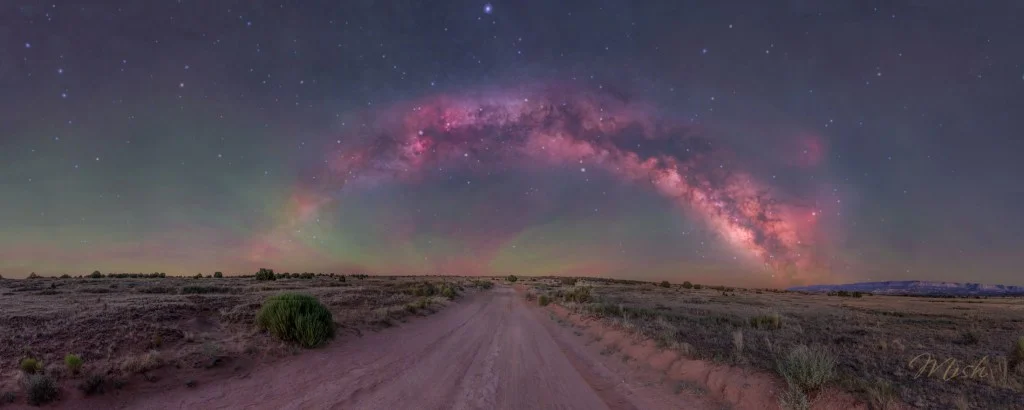
In May, I captured a stunning full arch image of the Milky Way at Grand Staircase-Escalante National Monument. This location is famed for its vast, dark skies, which offer unparalleled opportunities for astrophotography.
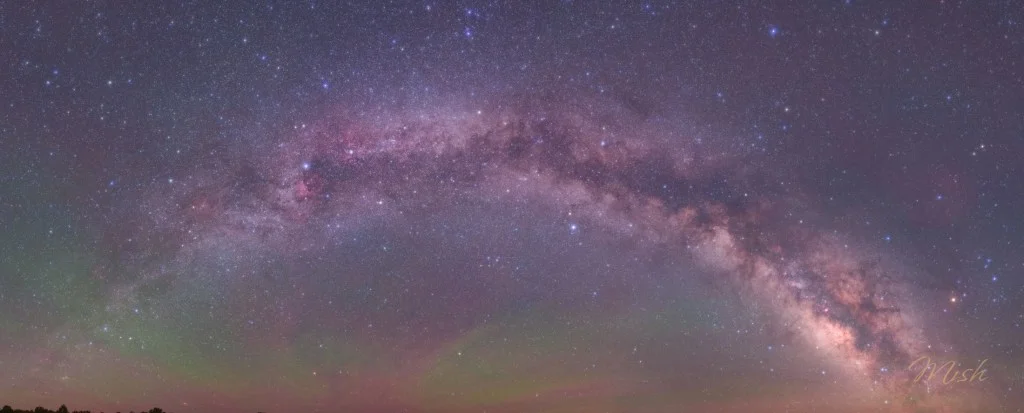
Understanding Airglow
Airglow refers to the faint, natural light emitted by a planet’s upper atmosphere, primarily influenced by solar radiation and chemical reactions. This phenomenon allows the night sky to subtly glow, even in complete darkness.
Colors and Chemical Reactions
- Green Waves: At altitudes of 90–100 km, excited oxygen atoms release green light (at 557.7 nm) as they return to a lower energy state.
- Orange/Red Undercurrents: Sodium atoms and hydroxyl (OH) molecules at similar altitudes produce warm orange and deep red tones.
- Gravity Waves: The atmospheric gravity waves create rippled patterns that signify turbulent air movements, influenced by the topography beneath.
When airglow occurs consistently at around 90 km, it typically forms a smooth layer of faint light. However, when atmospheric gravity waves disrupt the gas molecules in this zone, the intensity of the airglow fluctuates:
- The Wave Crest (Bright Bands): As the air compresses at the wave's peak, oxygen and sodium atoms cluster together, resulting in intensified chemical reactions that cause airglow to brighten significantly.
- The Wave Trough (Dark Gaps): Conversely, as air sinks and disperses in the troughs of the wave, the density decreases, leading to diminished airglow.
This cyclical behavior creates mesmerizing bands of green and orange light that stretch across the horizon.
11-Year Solar Cycle and Airglow
- Solar Maximum: Airglow interacts significantly with the Solar Cycle phases. During periods of solar maximum, heightened ultraviolet radiation heats the upper atmosphere, leading to a surge in airglow brightness.
- Brightness Increase: Research indicates that airglow can be up to 40% brighter during solar maximum phases compared to solar minimum phases. Keeping tabs on sunspot activity can help predict airglow conditions.
Gravity Wave Patterns
- The Trigger: Strong winds whipping across significant terrains, such as Grand Staircase-Escalante or the Rocky Mountains, can initiate gravity waves.
- The Push: These winds force large volumes of air upward when they encounter the mountain ranges.
- The Oscillation: Once this rising air meets stable layers above, gravity pulls it back down, creating a continuous movement that forms gravity waves.
Perfect Timing: Capturing the Milky Way
I took my images at 2:00 AM on May 20, the last opportunity to capture a full arch of the Milky Way before lunar conditions would interfere. At 1:00 AM, I awoke to what I thought was sleet; however, upon further inspection, it turned out to be diamond dust, often referred to as clear-sky precipitation. Fortunately, the skies were clear following a cold front that passed through earlier.
Diamond Dust and Cold Front Dynamics
Diamond dust formation involves a unique sequence of atmospheric events. The earlier cold front had unloaded dense Arctic air onto the desert floor, while higher altitudes remained relatively warm and humid. This combination allowed moisture to crystallize into tiny ice prisms, which fell gently through the starlit sky, mimicking sleet. This rare event resulted in intensified airglow during my capture.
How Cold Fronts Ignite Gravity Waves
The clash between cold and warm air created a type of turbulent wave propagation. The cold front, moving like a massive shockwave, transferred energy vertically, impacting the atmospheric layers up to 90 km. This compression of air was crucial for producing the striking colors of airglow that I captured across the night sky.
Why Mid-May is Ideal for Astrophotography
In mid-to-late May at 2:00 AM, the Milky Way core is perfectly positioned from the southeast to the northwest, providing an ideal backdrop for astronomical photography. Shooting during this time, right after the cold front had passed, resulted in exceptionally clear air, minimizing atmospheric haze and enhancing deep-space exposures.
Camera Setup and Techniques
I utilized a modified Canon EOS R5 camera from Spencer’s Camera, optimized to capture more of the red H-alpha wavelength. This modification boosted sensitivity to the faint colors typically blended into airglow images, resulting in richer color gradients.
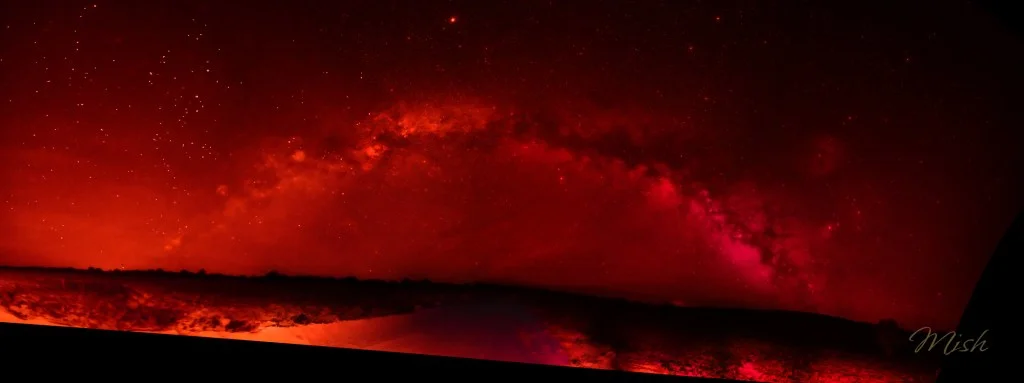
The final image is a meticulously stitched panorama, made from three complete sets of 220-degree images, amounting to a total of 72 blended shots. Each pano comprises 24 images, with the land captured via three focus-stacked images and the night skies twice-focused to reduce noise.
Taming the Starry Night
In my quest to create vivid frames, I confronted the overwhelming presence of stars—some images recorded over 44,000 stars. While many photographers enjoy this, I often prefer showcasing the Milky Way's structure with fewer distractions. For this purpose, there are apps designed to assist with star removal, albeit with limited success.
The H-alpha sequence selectively captures red wavelengths, isolating specific features without the usual background noise. This post-processing technique requires precision to overlay the desired H-alpha nebulas effectively.
Challenges with H-Alpha Filters
Working with H-alpha filters presents notable challenges, particularly in achieving focus at night. For Canon users, focusing in the field can be frustrating due to the filter’s density, so I’ve resorted to daytime focusing on far-off landmarks. By taping the lens after achieving focus, I ensure that it remains stable throughout my night sessions.
Using Star Trackers for Enhanced Imagery
I employed a Benro Polaris star tracker, a device that aligns with the Milky Way's rotation to minimize star movement in images. It's critical to separately capture land shots to prevent blurring. I typically photograph the land shortly after sunset during the blue hour for optimal light management.
For further details about using star trackers and essential equipment modifications, see my comprehensive review of the Benro Polaris star tracker here.
Do Star Trackers Fit Your Style?
Whether a star tracker suits your photographic pursuits largely hinges on how invested you are in learning its intricacies. While beneficial, the learning curves related to hardware and software can be steep. Yet, many photographers have gained substantial advantages from using trackers without the need for modified cameras.
Equipment Choices for Astrophotography
For my images, I selected a fast RF-mount 20mm f/1.4 lens, shot at f/2.0 (and f/1.8 for H-alpha sequences), mounted on my modified R5 camera. This lens strikes an ideal balance for wide-angle panoramas without compromising image quality.
Additionally, I utilized the Capture-the-Atlas Night Filter, which significantly enhances contrast while minimizing light pollution effects.
A Memorable Night Beneath the Stars
As I stood beneath the clear skies reflecting on my night of capturing celestial wonders, inspiration struck. When my alarm awakened me, it initially felt as though it was snowing—an illusion dispelled by the clarity of the sky above. This darkness made Grand Staircase-Escalante one of the best locations for stargazing in the United States.
This expansive view reveals not just the Big Dipper and North Star but stretches across a horizon encompassing over 180 degrees, truly showcasing the Milky Way’s splendor.
Looking ahead, my next posts will feature additional Milky Way images from locations like Bryce Canyon and Escalante. If you enjoyed this article, please consider sharing it or subscribing for more insights!
Fine Art Images
If you're interested in fine art for your walls, check out my collection at Mish Moments Fine Art Images.
Mike “Mish” Shedlock


